Dear, Moon.
Send my love
To where meaning has its place.
No dictionary--
Fold the universe for me
Shorten the way to my love.
🍀
graphs of my Universe

Dear, Moon.
Send my love
To where meaning has its place.
No dictionary--
Fold the universe for me
Shorten the way to my love.
🍀
Happy National Batik Day, dear Indonesia.
Godheg means sideburns in Javanese. Why is this batik named godheg, we can just assume that this is meant to highlight the value of sideburns when this batik pattern was composed.
Mbak Izzah could not give me exact answer when I asked her the meaning behind this batik. So like usual my wild creativity run to every nook and cranny of my imagination.
I remember my father liked to have nicely trimmed but rather thick sideburns. He said a man with sideburns looked handsome and masculine. He then said “Ini Bapak ganteng ya, Rike.” (Your father is handsome, Rike). I was mute not agreeing or disagreeing with his statement — admittedly my understanding about sexuality grew a bit later compared to my cheerful peer. Our mother always laughed teasingly when he gave himself compliments. We children just laughed as solidarity to those adult in love. 🤪
So honestly taking my father’s words (before further research) I claimed that batik Godheg was brought into existence by heaven knows which bloody Javanese man to celebrate the masculinity of the man wearing it.
By then Javanese men of high social and/or economic ranks who were definitely able to afford this batik would wear this pattern (Godheg) to attend functions or parties where they could show personification of masculinity in his class.
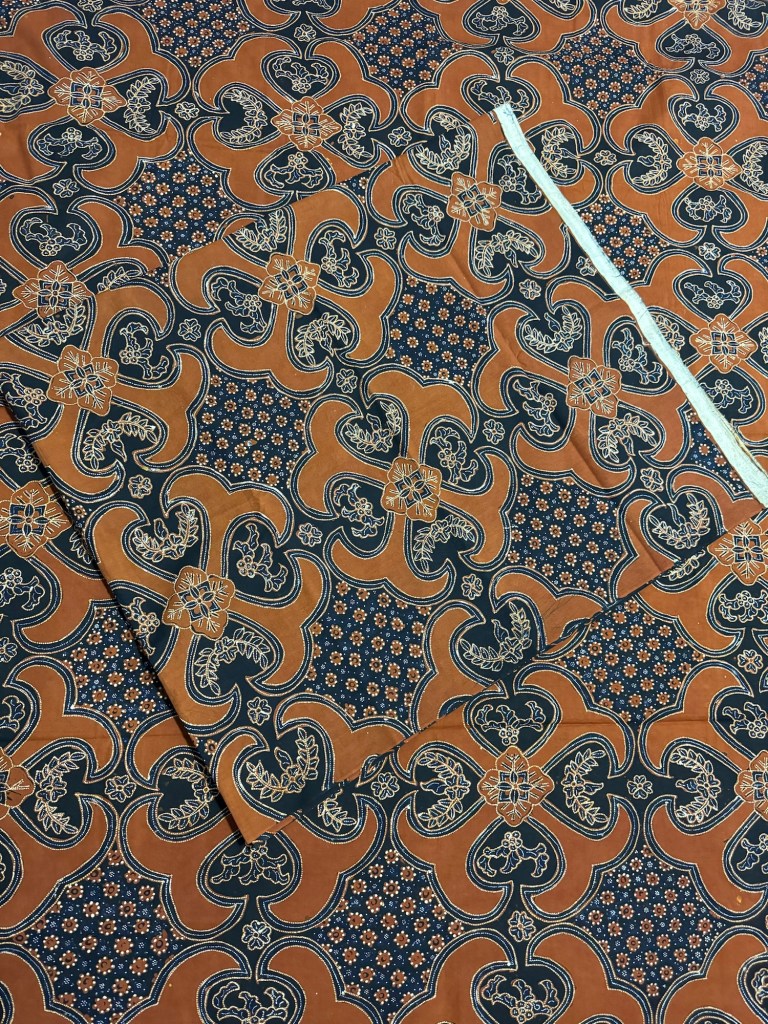
a pair of batik Godheg from Ibu Tien
matur nuwun, Ibu Tien — see you on either Oct 25 or 26, 2024 insya Allah
Browsing, I found one interesting article about sideburns in Javanese culture. It says that sideburns symbolise masculinity in traditional Javanese. Please allow me to include some excerpt below.
Jambang: Simbol Maskulinitas dalam Budaya Jawa

by: Lagan

Jambang, a traditional Javanese facial hair style, has long been a symbol of masculinity in Javanese culture. This unique style, which involves growing a mustache and beard, is not merely a fashion statement but a reflection of the wearer's character, social status, and spiritual beliefs. This article will delve into the significance of Jambang as a symbol of masculinity in Javanese culture.

The Historical Significance of Jambang

Jambang has a rich history in Javanese culture. It is believed to have originated from the ancient Javanese kingdoms, where it was worn by kings, nobles, and warriors as a symbol of power and authority. The style was also associated with wisdom and maturity, as it was typically worn by older men who had achieved a certain level of social status. The presence of Jambang was considered a sign of a man's ability to lead and protect his family and community.

Jambang and Javanese Masculinity

In Javanese culture, masculinity is not solely defined by physical strength or aggression. Instead, it encompasses a range of qualities such as wisdom, patience, self-control, and spiritual strength. Jambang, with its association with maturity and wisdom, perfectly embodies this nuanced understanding of masculinity. Men who wear Jambang are seen as embodying the ideal Javanese man, who is not only physically strong but also emotionally and spiritually mature.
The Spiritual Significance of Jambang

Beyond its social and cultural implications, Jambang also holds spiritual significance in Javanese culture. It is believed that the facial hair serves as a medium for spiritual energy, connecting the wearer to the divine. Some Javanese men even believe that growing a Jambang can enhance their spiritual practices, helping them to achieve a deeper level of meditation and connection with the divine.
Jambang in Modern Javanese Culture

Despite the influence of Western culture and modern fashion trends, Jambang continues to hold a special place in Javanese culture. Many Javanese men still choose to grow a Jambang as a way of connecting with their cultural heritage and expressing their masculinity. The style has also gained popularity among younger generations, who see it as a unique and stylish way to express their individuality and cultural identity.
In conclusion, Jambang is more than just a facial hair style in Javanese culture. It is a powerful symbol of masculinity, embodying the qualities of wisdom, maturity, and spiritual strength that are highly valued in Javanese men. Despite the changes in fashion and cultural trends, the significance of Jambang remains deeply rooted in Javanese culture, continuing to shape the way masculinity is understood and expressed.
Usedul link: https://www.questionai.id/amp/essays-e7pHAwYIR69/jambang-simbol-maskulinitas-dalam-budaya-jawa
I can't deny my instinct SOMETIMES can catch something on point. Please excuse my frankness; simply fulfilling a need to self appreciation. 😎
Back to batik Godheg….
It is a ceplok (cluster) batik in which the same pattern is repeated to form clusters that fill the whole sheet.

handsome batik indeed!
There are 4 pairs or godheg (sideburns) in each cluster and another inner and the center with also 4 parts as the elements.
Why 4?
4 is papat or sekawan or catur in Javanese, which symbolises creativity, intelligence, victory or even gold.
What’s more luxurious for Javanese men who traditionally artistic, cultural, silently dominant and (who is not) proud to be rich who can take care of the family decently. No wonder this batik use a lot of number 4 as its detail.
Do the numbers of dots in the isen (additional ornaments to fill in the blank spots among primary pattern on the sheet) also bear meaning?
Ahem! This is where imagination should be let be free.
Number 1 or siji, sawiji, esa, eka, ika, atunggal, tunggal, setunggal, symbolises unity, priority, the start, the world, the sun, the moon, country or kingdom, the king (leader), etc connotatively related to one existing. If ancient Javanese learn that there are two moons for certain period of time, they might omit the moon from the list.
Number 6 is nem, enem, enem, sad that symbolises emphaty and sympathy, humbleness, wise and wisdom, highly educated or scholar, etc.
Number 8 is wolu, asta, manggala that symbolises benevolence, honored, high rank, etc. Dragon in Javanese culture is also connoted to number 8 – why? Heaven knows!
If I may challenge all Javanese men who still consider themselves handsome Javanese, please kindly refer to these numbers to project their perfection and to evaluate their existence. 🤩
Do I truly mean with all my description of number of dots in the batik? Don’t quote me, I am speculating about most of what I say about the meaning behind batik patterns. All those symbols are taken from responsible sources of Javanese tradition though; so the number symbols are legit.
Or probably to quote Mbak Izzah’s random words when she thinks my questions are too intimidating: “Maybe the batik maker wanted to put 5 dots and no other intention, Mbak Rike.”
🤪
Once again….
Happy National Batik, Indonesia❣️
Time for me to take a rest…. I will rise earlier to go across the strait to Johor at 5am tomorrow.
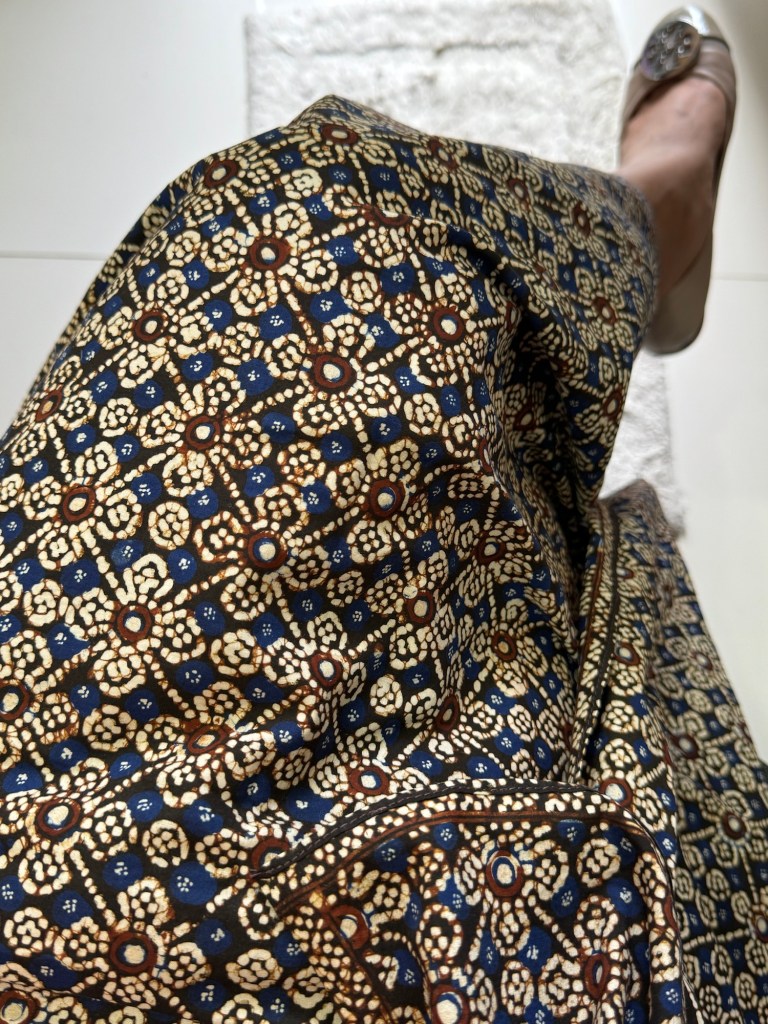
today’s apparel was batik skirt (from manually folded batik sheet) with red top to celebrate Indonesia’s National Batik Day
it is Batik “Nitik Sekar Kentang Bribilan Sogan Kerok”
💕
Stepping in
To the wood
Under the sun,
The moon,
The stars,
Swarmed by the wild;
Ahead she prances
Along a composition
Orchestrated by the air.
—
be a fool in the ocean of falsehood
realizing that being a fool is an enjoyable journey in life to earn meanings without burden
My breathing is poetry.
It brings in inspiration,
Emits meaning.
My dreaming is poetry.
It attracts hopes,
Depicts reality.
My walking is poetry.
It steps on milestones,
Follows you.
——
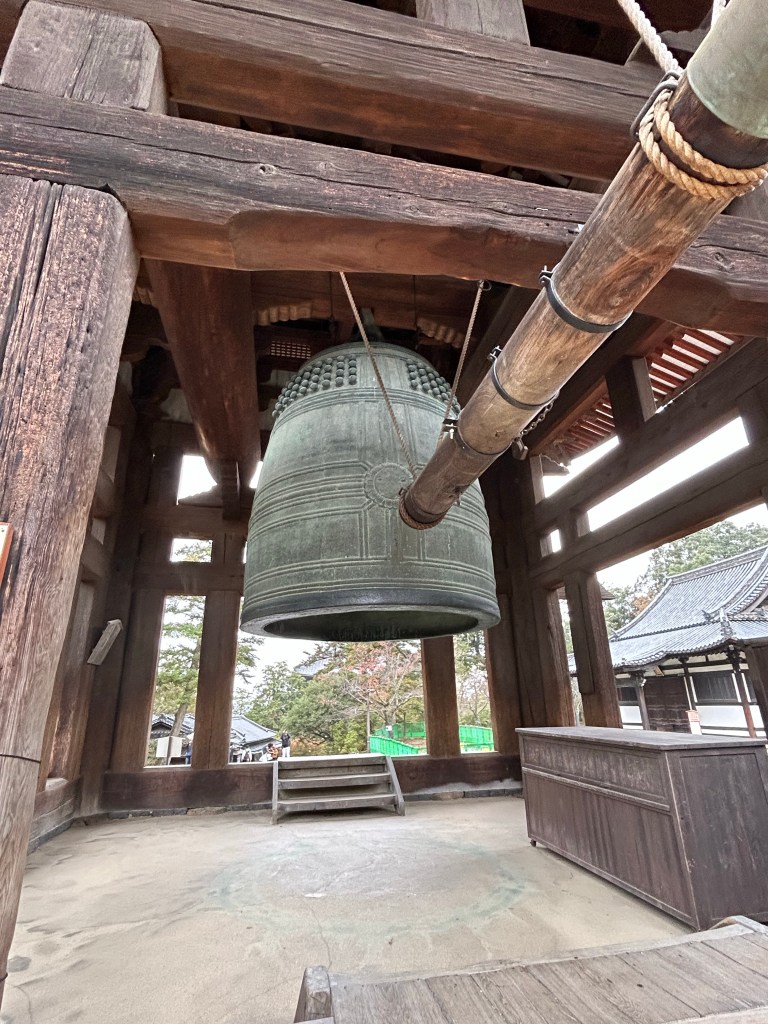
when time is coming, let my poetry be with me 💕
There are star clusters
Glowing in the horizon
Sending messages.
——
From Yogyakarta I brought home a pair of batik grompol sheets which I ordered 6 months ago. Happy I must be!
Grompol is a Yogyakartan special classical batik pattern. No other regions can claim otherwise.

Let’s talk about batik grompol today.
Disclaimer: 1) while the primary interpretation is based on what I learnt from the masters; many of it is my own thought based on what I understand on symbols and signs of Javanese, Islam and Hinduism that intertwined in my upbringing. So please be critical. 2) too much information, too little time for me to summarise. Please expect disconnected ideas, connect them by yourselves.
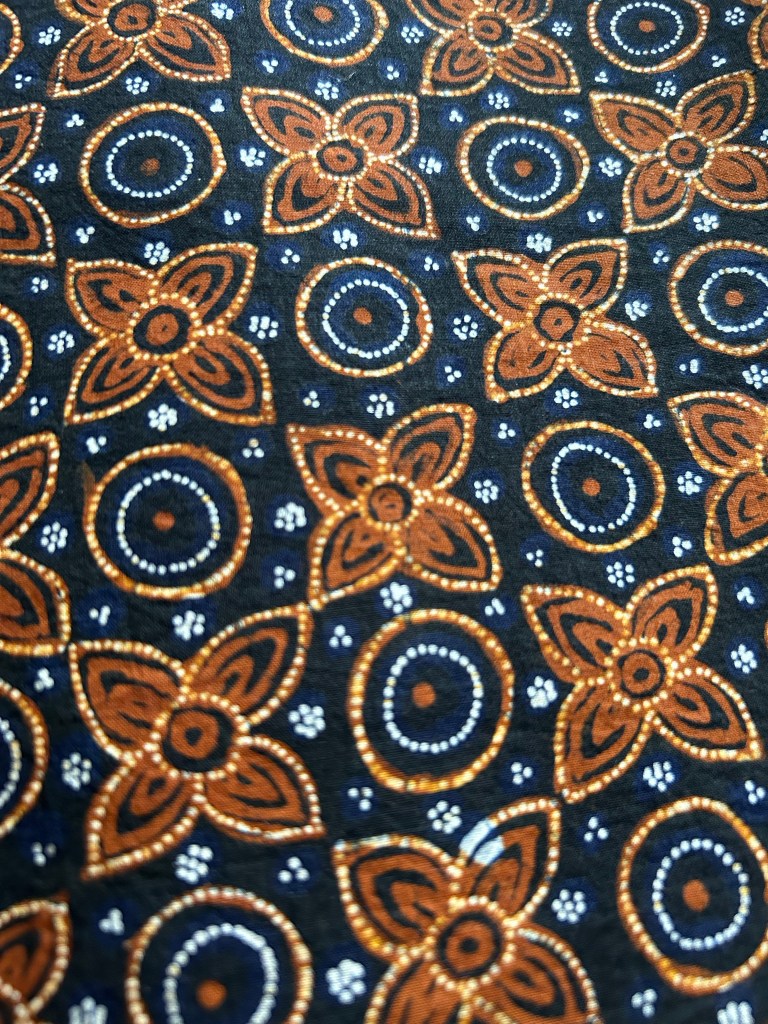
Grompol batik pattern is a sub-category of ceplok pattern in which one geometry pattern is clustered (squares, triangle, circle, lines, etc). In Javanese language ceplok literally means clustering, grouping, gathering based on the same characteristics or criteria (size, colour, shape, pattern, lines, etc). So hypothetically ceplok pattern is always about gathering, uniting, getting together.
Grompol pattern is characterised through the clustering of of 4-petal flower, a flower pistil in the middle, a seed with 4 couples of 3-ceceg and 5-ceceg (ceceg is a terminology used to describe dots in batik pattern) and “wrapped” by a square with 8 points that almost looks like octagram.
Flower
4-petal flower is a symbol of fertile or healthy life. The 4 petals of the flower can be related to four points of the compass: east, west, north and south.
Flower pistil symbolises the centre of life, potential growth in human being. It can also represent the sun, the soul, the heart as centres of discourses to be applied based on contexts.
Flower which is the beauty before fruition is representing an expectation that human being should optimise their state of beauty which in Javanese almost always refers to the developed wisdom in human being manifested as kindness to fellow creature on earth before one dies.
Seed
A round seed surrounded by 4 couples of 3-ceceg and 5-ceceg symbolises seed of life that should be well protected from all directions.
The seed can be interpreted the same as the flower pistil in the middle of a flower. It is generated from the pistil fertilised by the pollens. It is the centre of life, potential growth in human being. It can also represent the sun, the soul, the heart as centres of discourses to be applied based on contexts.
The round shape of the seed indicates the completeness, thoroughness, integration, centredness, perfection, full cycle.
Ceceg is one type of isen (ornament in empty spaces among primary patterns of batik) in batik. Isen is more popular in Central Java than other regions, isen can be in the form of dots or lines or the combination of both repeatedly put in the intended empty spaces without changing the primary pattern, even there is an intension for isen to highlight the primary patterns.
3-ceceg can be interpreted as Trimurti, the three balancing power of Brahma, Wisnu and Siwa (Siva) which are the 3 powerful powers of creation of the universe, preservation of the universe and destruction of the universe.
5-ceceg can be interpreted as 5 types of self regulation: knowing one’s own identity and personality, connecting to inner self, managing the humane desires, living through good sources of life (no corruption, sharing to the needy) and self reflection through traveling or pilgrimage. A human being is expected to continuously strive for perfection of these five without expecting the perfection to happen.
Points of the Compass
Octagram represents 8. Number 8 in Javanese wisdom is about welfare and authority. Number 8 also represents 8 gods guarding the 4 points of the compass in which 1 direction is guarded by 2 gods of specific authority. The compass itself has 9 points – 1 the centre, 8 the directing points.
The 1 point in the middle is sat by Siwa. 8 points are sat by other gods based on what they manage in the natural realm. Those 9 (1+8) are called Dewata Nawa Sanga (nine guardian gods) in Balinese and Javanese culture. Those 8 are wellknown as Asta Dikplaka (eight gods of 8 directions).
Number 1, 3, 4, 5, 8, 9
Like in other cultures, Javanese gives significant role to numbers in their game of meaning.
Summary
That it is a ceplok type signifies the clustering, gathering, integrating of certain characters. So this batik is message and prayer for uniting of between or among family members. It is also a message and prayer of integration of human being internal wisdom – a state of maturity. Batik grompol is often worn by bride and groom in their wedding day due to its very sacred meaning of ultimate protection and potential growth through a gathering.
The uniting or integration should be based on clarity of wisdom and protection. It is the wisdom personally and culturally harvested and nurtured. The beholder, owner, wearer of batik grompol is expected to realise that this pattern is a message and a prayer that they are well protected at the same time expected to extend the given protection to all directions as the gods of all points of compass spread their protection to the universe.
The pistil of the flower as the potential growth in human being put as a compass centre in human being life can be interpreted that human being integrated wisdom has as strong power as Siwa who is sitting at the centre of the compass/chakra. Although described as destroying god, Siwa is actually symbol of re-creating, re-cycling. His being sat in the centre of a chakra (wheel, cycle) is significantly describing him as recreation/recycling agent who then distributes the re-created/re-cycled material to different function around him to be re-governed wisely by “different gods” (remember the 8 gods of all directions).
A human being should be able to learn, re-learn and un-learn one’s own life experience and lessons then to better redo or re-process the way one solves problems or to simply treat other creatures.
The round seed means a centred human being who has achieved the understanding of integrity, full cycle of life. It doesn’t mean the human being is flawless; it means the human being is aware of one’s flawedness yet accepting the state of imperfection of being human. And through the acceptance the human being keeps bettering one’s self in treating one’s self, fellow creatures and the nature. This is an everlasting interaction and intertwining between micro cosmos (jagat alit in Javanese language which represents human being) and macro cosmos (jagat gedhe, the universe).
And all in all, a human being shall pray to his God or make one’s self sure that to any direction one is heading to, one is safe and peaceful. Religious human being will live through guidance and protection from God. Spiritual human being will find inner centre in one’s self whatever one calls it and focus on what one is doing in honesty and sincerity. Free thinker will boost one’s self confidence and focus on what one is aiming with integrity.
So batik grompol has helped me understand that all my fellow human beings are essentially doing the same things as what I am doing in my life, just explained through different perspectives; and we are only of different pace and timing.
What a beautiful batik pattern. What a beautiful meaning.

my beautiful grompol batik cloths were born through the golden hands and soul blessed to this beautiful lady, Ibu Tien Wartienah
I’ll love
No matter what
I’ll be over anyways.
I’ll work
No matter what
I’ll be over anyways.
There is me
Or not,
It might be the same.
Yet as long as there is me,
I’ll do what I can
To add more
Meanings
And
Utility
To my life.
I’ll love
No matter what
In life.
Life is good,
I won’t skip
A thank
And
Or
Cheers.
—

listen to love; it is everywhere 💕
Blueprint, Beloved,
Life in black and white. Colour!
With meanings and vibes—
—
Happy life is a sketch before coloured. The same sketch in the hands of different human beings can have different colour composition that bring different vibes and nuance. Neuroscientist’s perspective of happiness is different from artist’s. The haves’ perspective of happiness is different from the have nots’. A wanderer’s perspective of happiness is different from a homebody’s. Et cetera…
Yet it is still happiness in its original design.
It is a feel of happiness when I shed tears then realising that life is more than crying on failure or accidents; life is seeing failure or accidents as blessings. Imagine how happy a person was knowing that she was late for boarding losing mega business opportunity then after that learning that the plane she was supposed to board crashed in which all passengers were dead. A blessing in disguise! Life is more precious than any business!
Thank you for this subtle reminder about putting some bright colours where dreary feeling resides.
Baby step to grow wiser…. Very slow but I’m sure I’ll be a wise old lady. 😁 Hey, hey! Don’t forget to dye your hair!

Lapisan lambang, makna, ilmu –
Cahaya di atas Cahaya
What you can capture with the eyes are those reflecting the light. The intensity of the Light affect the clarity of the object reflected to the lenses inside of your head.
But what is that object? That depends on what you have been informed through your experience from time to time. The longer the time, the more extensive the description of the object will be. The more frequent the object is scrutinised, the more comprehensive the description will be.
And if you are exchanging with more directions of sources, the object has become not only a description of what the Light has reflected to the lenses inside of our head but you will find that the object becomes a plane to define something else. It has turned into a symbol defining a meaning. The more expressive the symbol is defined, the deeper you search into yourself. And deeper deeper deeper to the abyssal ocean of inner knowledge. From your eyes to your head to your mind to your heart to your bottomless self….
Bottomless self?
It is where you’ll find the meaning of the meaning of the meaning of the meaning of the meaning of the meaning of the meaning……..of what reflected to the lenses inside of your head.
Layers of meaning is layers of Lights.
Light on light on light on light on light on light….
Light upon Light!
Muar – January 11, 2018 – 00:50
Pronouncing good word,
Parrot is nodding its head.
When word is just word.
What does a word mean when it is uttered by a bird, it only repeating what it has heard from environment without knowing what it means. It means…. Meaning is not everything but it is more essential than just the pronounced lining letters.
Life, teach me about what essential when I pronounce a good word as I am not a parrot or any other copiers.

Picture borrowed from National Geography
Singapore – July 21, 2016 – 2:45pm
 rike jokanan
You must be logged in to post a comment.